Russian Grammar Nutsie
Russian cases, numbers, aspect and everyday phrases — every case with a shape and a colour of its own.
Russian Grammar Nutsie
Russische Fälle, Zahlen, Aspekt und Alltagssprache — jeder Fall mit eigener Form und eigener Farbe.
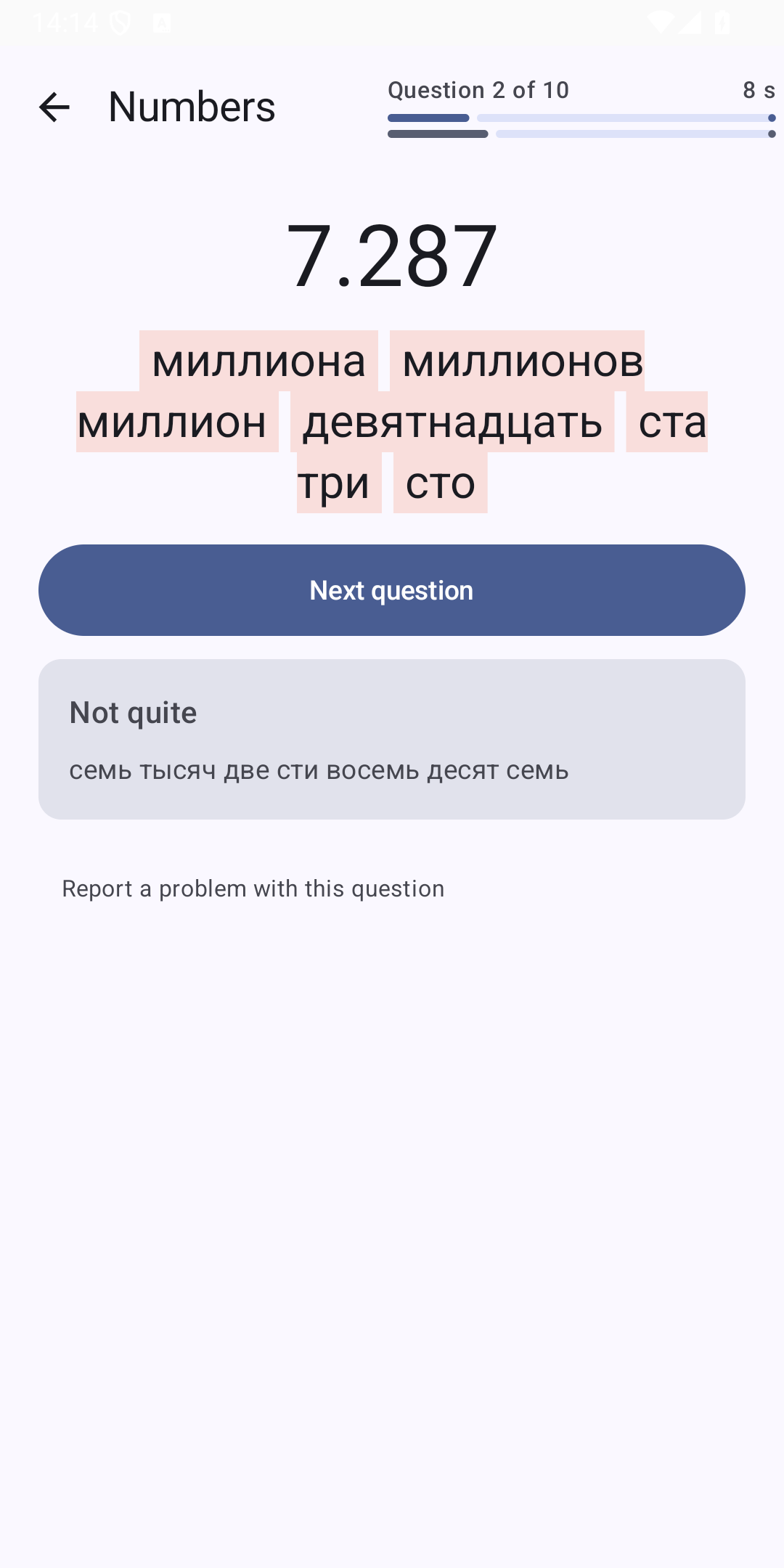
Russian Grammar Nutsie is not a vocabulary drill. It practises the parts that stop you being understood in Russian: which case a preposition takes, how a Russian number is actually spelled out, whether an action was finished or ongoing, how an adjective agrees with its noun, and what a Russian speaker would really say in the situation you are standing in.
Seven trainers share one screen and one set of statistics. Several people can use the same phone without sharing a score: a profile is a name you type, and each one counts its own right and wrong answers per module and per day.
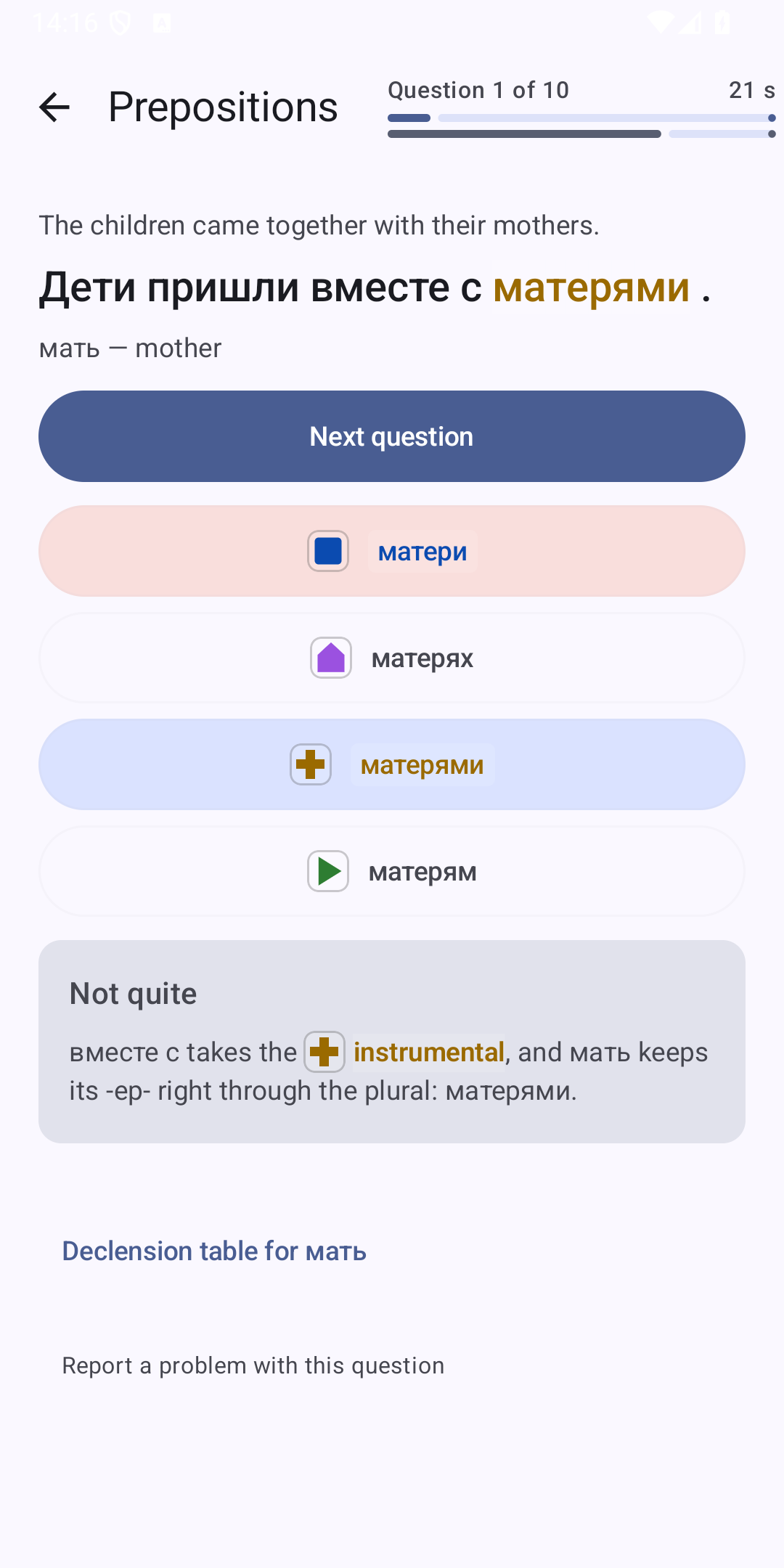
Every case carries a mark and a colour of its own — nominative , genitive , dative , accusative , instrumental , prepositional — and the two verb aspects have a pair of their own: for the imperfective, for the perfective. Those are the marks as the app draws them. The same one follows a case everywhere it appears: on each answer option, inline in the explanation beside the name of the case, and down the declension table.
That is dual coding — the principle that something stored twice, once as a word and once as a picture, has two routes back to you instead of one — and a shape unlike every other shape on the screen is the one that stands out from them. means dative before you have read the word, and after a hundred sessions it keeps meaning it. The shape is what carries the meaning and the colour is the mnemonic on top of it, so the scheme survives being seen in greyscale or by a colour-blind reader, and every mark has a spoken name for a screen reader.
You choose the language twice over: the interface is English, German or Russian, and the explanations come in all three, whichever the interface is set to.
All the learning material is bundled inside the app. There is no account, no sign-up and no tracking, and nothing about how you answer is ever uploaded. Speech input is optional and off by default, and nothing in the app is locked.
What it does
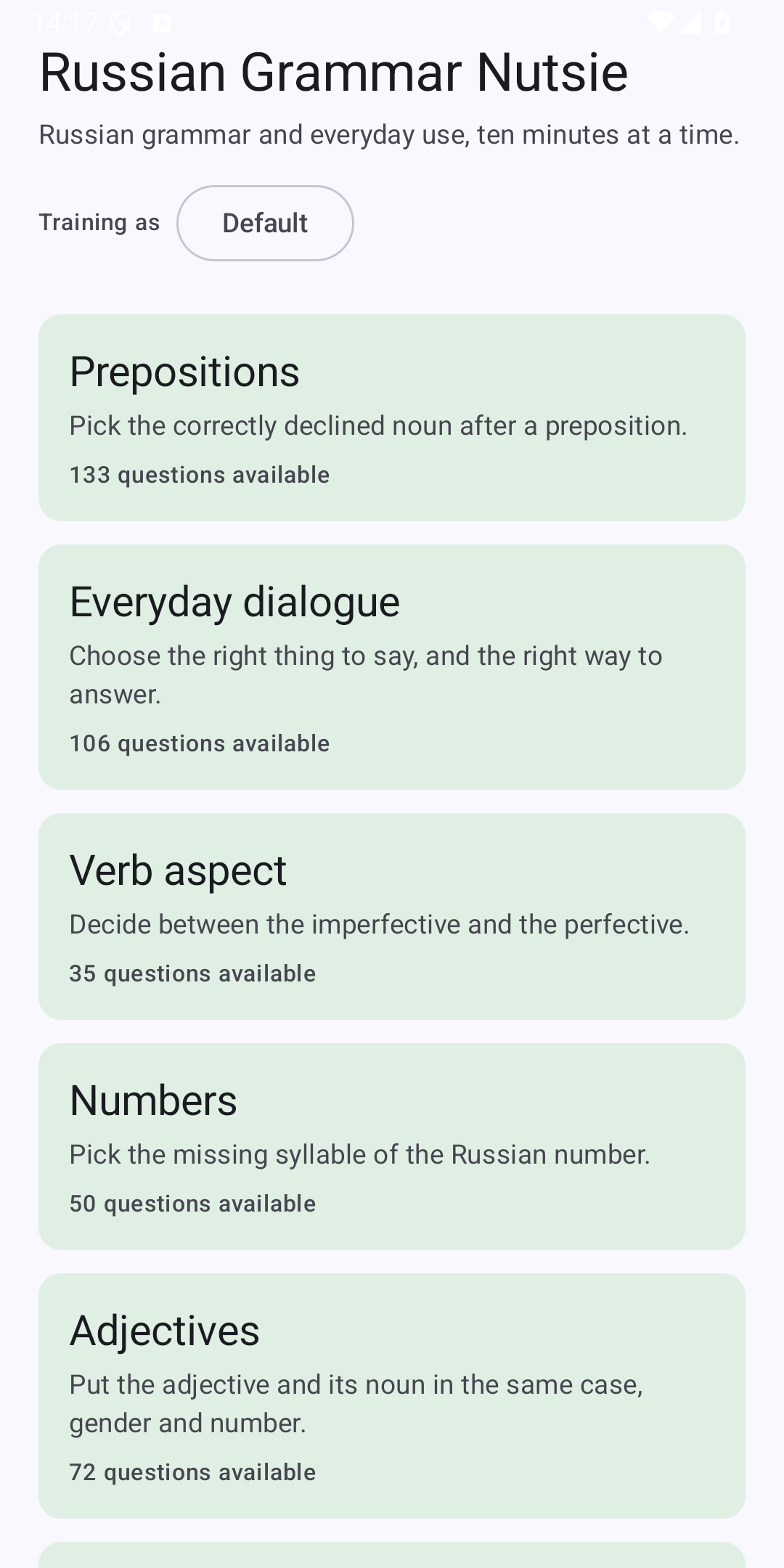
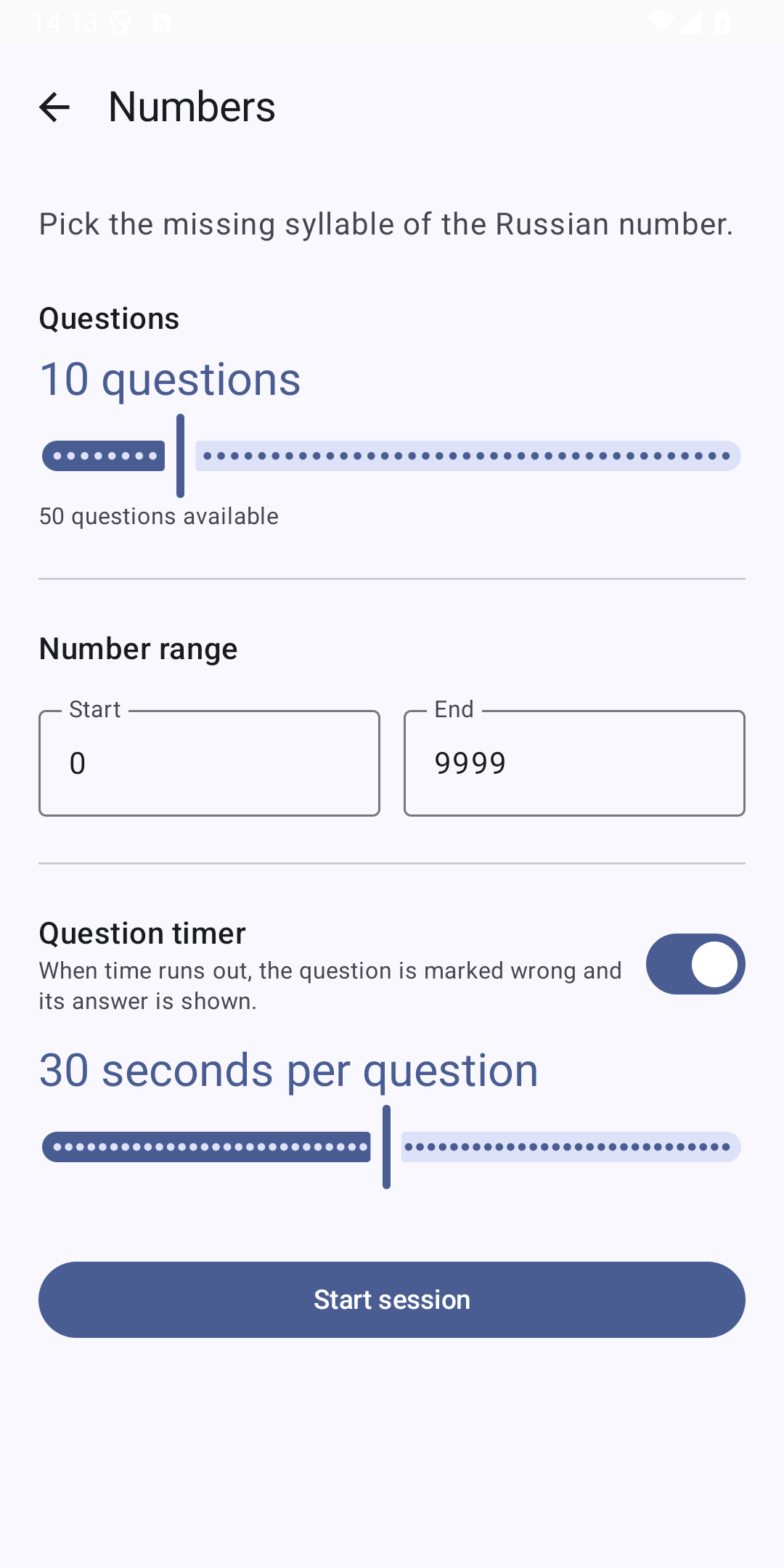
- Seven trainers — prepositions and cases, numbers, everyday dialogue, verb aspect, adjectives, pronouns and body parts — in configurable sessions of 1 to 50 questions, with an optional per-question timer.
- Every quiz option is a genuine form of the same word, so you choose between real Russian rather than spotting a typo.
- Six cases, six marks and six colours: nominative , genitive , dative , accusative , instrumental , prepositional — and and for the two verb aspects.
- The same mark follows a case through the answer options, the explanation and the declension table: stored as a word and as a picture, it has two routes back instead of one.
- The shape carries the meaning and the colour is the memory hook, which is why the scheme survives colour blindness; every mark has a spoken name for screen readers.
- Explanations after each answer show the rule, with the case mark inline and the endings coloured; the reference screen lists every word with a full declension table.
- Search the reference from Russian, English or German, and from an inflected form — type домом and it finds дом.
- Profiles: several people share one phone without sharing one score, and each profile keeps its own right/wrong counts per module and per day.
- Interface in English, German or Russian, and explanations in all three.
- Optional speaking and text-to-speech, both off by default; the app works silently with touch alone.
- No account, no sign-up and no tracking; the learning material is bundled, so a session needs no connection.
Russian Grammar Nutsie paukt kein Vokabular. Es übt das, woran Verständigung im Russischen tatsächlich scheitert: welchen Fall eine Präposition verlangt, wie eine russische Zahl wirklich ausgeschrieben wird, ob eine Handlung abgeschlossen war oder dauerte, wie sich ein Adjektiv nach seinem Substantiv richtet, und was eine russische Sprecherin in der Situation wirklich sagen würde.
Sieben Trainer teilen sich einen Bildschirm und eine Statistik. Mehrere Leute können dasselbe Telefon nutzen, ohne sich einen Punktestand zu teilen: Ein Profil ist ein Name, den du eintippst, und jedes zählt seine eigenen richtigen und falschen Antworten pro Modul und pro Tag.
Jeder Fall trägt ein eigenes Zeichen und eine eigene Farbe — Nominativ , Genitiv , Dativ , Akkusativ , Instrumental , Präpositiv —, und die beiden Verbalaspekte haben ihr eigenes Paar: für den unvollendeten, für den vollendeten. So zeichnet die App sie. Dasselbe Zeichen begleitet einen Fall überall: auf jeder Antwortmöglichkeit, mitten in der Erklärung neben dem Namen des Falls und in der Deklinationstabelle.
Das ist duale Kodierung — der Grundsatz, dass etwas zweimal Abgelegtes, einmal als Wort und einmal als Bild, zwei Wege zurück hat statt einem —, und eine Form, die keiner anderen auf dem Bildschirm gleicht, ist die, die sich abhebt. heißt Dativ, bevor das Wort gelesen ist, und nach hundert Einheiten heißt es das immer noch. Die Form trägt die Bedeutung, die Farbe ist die Eselsbrücke darüber; das Schema übersteht also Graustufen ebenso wie eine Farbsehschwäche, und jedes Zeichen hat einen gesprochenen Namen für die Vorlesefunktion.
Die Sprache wählst du doppelt: Die Oberfläche spricht Englisch, Deutsch oder Russisch, und die Erklärungen kommen in allen dreien — unabhängig davon, worauf die Oberfläche steht.
Der gesamte Lernstoff steckt in der App. Es gibt kein Konto, keine Anmeldung und kein Tracking, und nichts über deine Antworten wird hochgeladen. Das Sprechen ist optional und standardmäßig aus, und nichts in der App ist gesperrt.
Was sie tut
- Sieben Trainer — Präpositionen und Fälle, Zahlen, Alltagsdialoge, Verbalaspekt, Adjektive, Pronomen und Körperteile — in Einheiten mit 1 bis 50 Fragen und optionalem Zeitlimit pro Frage.
- Jede Antwortmöglichkeit ist eine echte Form desselben Wortes; du wählst zwischen richtigem Russisch, nicht „Finde den Tippfehler“.
- Sechs Fälle, sechs Zeichen und sechs Farben: Nominativ , Genitiv , Dativ , Akkusativ , Instrumental , Präpositiv — und und für die beiden Verbalaspekte.
- Dasselbe Zeichen begleitet einen Fall durch die Antwortmöglichkeiten, die Erklärung und die Deklinationstabelle: einmal als Wort und einmal als Bild abgelegt, hat er zwei Wege zurück statt einem.
- Die Form trägt die Bedeutung, die Farbe ist die Eselsbrücke — deshalb übersteht das Schema eine Farbsehschwäche; jedes Zeichen hat einen gesprochenen Namen für die Vorlesefunktion.
- Erklärungen nach jeder Antwort zeigen die Regel, mit dem Fallzeichen im Text und farbigen Endungen; der Referenzbildschirm listet jedes Wort mit vollständiger Deklinationstabelle.
- Durchsuche die Referenz auf Russisch, Englisch oder Deutsch — auch nach einer gebeugten Form: Tippe домом und du bekommst дом.
- Profile: Mehrere Leute teilen sich ein Telefon, ohne sich einen Punktestand zu teilen, und jedes Profil zählt eigene richtige und falsche Antworten pro Modul und pro Tag.
- Oberfläche auf Englisch, Deutsch oder Russisch, und Erklärungen in allen dreien.
- Optionales Sprechen und Vorlesen, beides standardmäßig aus; die App funktioniert lautlos allein per Tippen.
- Kein Konto, keine Anmeldung, kein Tracking; der Lernstoff ist eingebaut, eine Einheit braucht also keine Verbindung.
Your data
All the learning material is bundled inside the app. Your settings, your profiles and the right/wrong counts behind them are stored on the device and never transmitted; there is no account and nothing about how you answer is uploaded. Reporting a question you think is wrong is opt-in per report and sends the question id, the reason and anything you type to our own server in the EU — never your answers or your profile. Everything else the app can send is listed in its privacy policy, and anything optional stays off until you switch it on.
Deine Daten
Der gesamte Lernstoff steckt in der App. Deine Einstellungen, deine Profile und die Zähler dahinter werden auf dem Gerät gespeichert und nie übertragen; es gibt kein Konto, und nichts über deine Antworten wird hochgeladen. Eine Frage zu melden, die du für falsch hältst, entscheidest du pro Meldung; gesendet werden die Fragen-ID, der Grund und was du schreibst — an unseren eigenen Server in der EU, nie deine Antworten oder dein Profil. Alles andere, was die App senden kann, steht in ihrer Datenschutzerklärung, und alles Optionale bleibt aus, bis du es einschaltest.